
A practical, lower-carbohydrate approach to building a better plate
If you have spent any amount of time trying to lose weight or improve your health, you’ve probably heard the word “macros.”
Count your macros.
Hit your macros.
Adjust your macros.
But what exactly ARE macros?
“Macros” is simply short for macronutrients – the nutrients our bodies need in relatively large quantities. There are three major macronutrients in the foods we eat: protein, fat, and carbohydrates.
And while all three can have a place in a healthy diet, they do NOT behave the same way once they enter your body.
Let’s break them down.
PROTEIN: MORE THAN JUST MUSCLE
Protein is made up of amino acids, which your body uses to build and repair tissues throughout the body.
Yes, that includes muscle – but protein is involved in MUCH more than building biceps.
Your body uses amino acids to make enzymes, hormones, antibodies, structural proteins, and countless other molecules necessary for life.
Protein is also incredibly useful when trying to improve metabolic health because it tends to be very satiating. In plain English: protein helps you stay full.
Think eggs, fish, chicken, turkey, Greek yogurt, cottage cheese, seafood, meat, nuts, seeds, beans and legumes.
As we age, maintaining adequate protein becomes even more important because preserving lean muscle mass matters for strength, mobility, glucose metabolism, and long-term health.
So protein isn’t something I want you afraid of.
I want it to have a prominent place on your plate.
FAT: THE MACRONUTRIENT WE SPENT DECADES FEARING
For years, fat was the nutritional villain.
Fat makes you fat, right?
Well…not exactly.
Dietary fat is essential for normal physiology. We need fat for cell membranes, hormone production, absorption of fat-soluble vitamins, brain function, and many other processes.
Fat also provides energy and helps make meals satisfying.
But, just like carbohydrates, the source matters.
Avocados, olives and olive oil, nuts, seeds, eggs, and fatty fish provide very different nutritional packages than highly processed foods containing combinations of refined starch, sugar, and fat.
That distinction matters.
I’m not suggesting you start pouring butter into your coffee and eating bacon at every meal simply because someone on the internet told you carbohydrates are bad.
The goal isn’t to replace one extreme with another.
The goal is to eat FOOD.
AND THEN THERE ARE CARBOHYDRATES…
This is where things get interesting.
Carbohydrates include sugars, starches, and fiber. They are found in everything from broccoli and blueberries to bread, cookies, cereal, pasta, soda, and candy.
And this is exactly why saying “carbs are bad” doesn’t make much sense.
Broccoli is a carbohydrate.
An apple contains carbohydrates.
So do lentils.
So does a 32-ounce soda.
Clearly, those foods shouldn’t all be placed into the same nutritional bucket.
I’ve said this before, and I’ll say it again: to my knowledge, no one developed diabetes because they ate too much broccoli.
The problem with the modern American diet isn’t simply that carbohydrates exist.
The problem is the amount and TYPE of carbohydrate many of us consume.
WE EAT A LOT OF CARBOHYDRATES
The average American adult gets roughly 46-48% of daily calories from carbohydrates. Depending on total calorie intake and the population studied, that commonly represents roughly 200-300 grams of carbohydrate per day.
On a 2,000-calorie diet, 47% of calories from carbohydrate is about 235 grams per day.
Now, I don’t believe everyone needs to eat a ketogenic diet.
In fact, I don’t think most people need to obsess over getting their carbohydrate intake down to 20 or 30 grams per day.
But I DO think many Americans would benefit from eating fewer carbohydrates – particularly refined carbohydrates and added sugars.
The American Diabetes Association recognizes low-carbohydrate eating patterns as one potential approach. In its nutrition materials, a low-carbohydrate pattern is generally described as about 26-45% of calories from carbohydrates, while very-low-carbohydrate patterns fall below 26%.
So there is an enormous amount of room between a high-carbohydrate modern diet and a ketogenic diet.
That’s the space where many people may find a sustainable lifestyle.
WHY DO CARBOHYDRATES MATTER SO MUCH FOR INSULIN?
When you eat digestible carbohydrates, they are broken down largely into glucose.
Glucose enters your bloodstream, and your pancreas responds by releasing insulin.
Think of insulin as one of the body’s major nutrient-storage signals. Among its many jobs, insulin helps move glucose from the bloodstream into cells where it can be used or stored.
This system is NORMAL.
Eating an apple and releasing insulin isn’t a disease.
Eating a sweet potato and releasing insulin isn’t a disease.
The problem develops when our metabolic environment becomes abnormal.
Many people spend years eating large amounts of refined carbohydrates, added sugars, and ultra-processed foods while also eating frequently throughout the day and consuming more energy than their bodies need.
Breakfast. Snack. Lunch. Snack. Dinner. Dessert. Maybe another snack before bed.
Over time, excess body fat, chronic overnutrition, physical inactivity, genetics, sleep, and dietary quality can all contribute to insulin resistance – a state in which cells don’t respond to insulin as effectively as they once did.
The pancreas initially compensates by producing MORE insulin. Blood sugar may therefore look “normal” for years while insulin levels are already elevated. Eventually, that compensation may no longer be enough. Blood glucose rises. Prediabetes develops. And, in susceptible individuals, Type 2 diabetes can follow.
This is one reason reducing our carbohydrate burden – particularly refined carbohydrates – can be a practical place to start.
Importantly, the 2026 American Diabetes Association Standards of Care say reducing carbohydrate intake can be considered for some adults with diabetes to improve glycemia, while emphasizing minimally processed, nutrient-dense, high-fiber carbohydrate sources.
You don’t necessarily have to eliminate carbohydrates.
You need to become much more selective about them.
SO…WHAT SHOULD I ACTUALLY EAT?
Nutrition advice has become ridiculously complicated.
So let’s make this SIMPLE.
You don’t necessarily need a food scale. You don’t need to calculate the macronutrient composition of every bite. And you certainly don’t need to spend your entire life entering food into an app.
Start with your plate.
Imagine dividing your plate into four equal sections.
ONE-HALF OF YOUR PLATE: PROTEIN + HEALTHY FAT
Make approximately half of your meal centered around protein and naturally occurring or minimally processed healthy fats.
Think chicken, fish, eggs, turkey, seafood, lean or minimally processed meats, Greek yogurt, cottage cheese, tofu, nuts and seeds, avocado, and olive oil.
Protein should be the anchor of the meal – not an afterthought.
ONE-FOURTH OF YOUR PLATE: NON-STARCHY VEGETABLES
Load this portion with plants: broccoli, cauliflower, asparagus, cabbage, Brussels sprouts, green beans, peppers, leafy greens, mushrooms, and zucchini.
Yes, vegetables contain carbohydrates.
I’m not worried about the carbohydrates in your broccoli.
These foods bring fiber, micronutrients, phytochemicals, and volume to the meal while generally producing a much smaller glucose response than refined starches and sugars.
THE FINAL ONE-FOURTH: WHOLE FRUIT
And here’s where I do something a little differently.
Make fruit your dessert.
Berries. An apple. An orange. Peaches. Melon. Whatever whole fruit you enjoy.
Eat your protein, healthy fats, and vegetables first and enjoy the fruit at the END of your meal.
Notice I said whole fruit.
Not fruit juice. Not a “fruit snack.” Not a giant smoothie containing four bananas, mango, pineapple, dates, honey, and enough fruit to feed a small family.
Whole fruit.
Fruit comes packaged by nature with water, fiber, vitamins, minerals, and phytochemicals. You have to chew it, and it takes time to eat.
That’s very different from drinking its sugar through a straw.
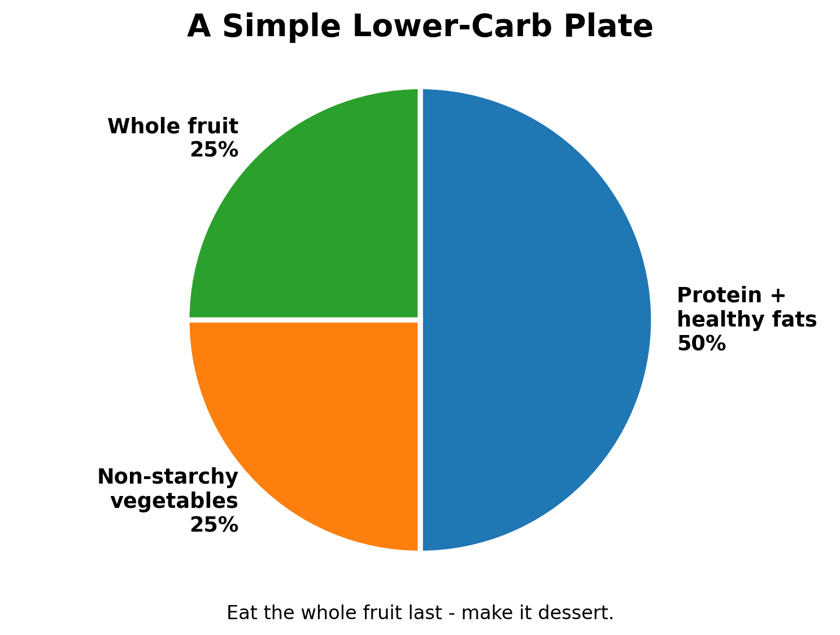
The Fasting Doctor lower-carb plate: 1/2 protein + healthy fats, 1/4 non-starchy vegetables, 1/4 whole fruit.
WHAT’S MISSING FROM THE PLATE?
You may have noticed something.
Where’s the giant pile of pasta? Where’s the bread basket? Where’s the rice? Where are the french fries?
They’re not required at every meal.
That doesn’t mean you can NEVER eat bread, potatoes, rice, or pasta again.
I don’t believe sustainable nutrition requires living the rest of your life terrified of a potato.
But those foods don’t need to be the FOUNDATION of every meal either.
If your current diet contains cereal for breakfast, a sandwich and chips for lunch, pasta for dinner, soda throughout the day, and cookies afterward, simply changing the proportions on your plate could dramatically reduce your daily carbohydrate intake without ever counting a single gram.
THAT is what I mean by low carb.
Not necessarily keto.
Not zero carb.
Not “never eat another piece of fruit.”
Just LOWER carb.
START WITH REAL FOOD
If you’re overwhelmed by nutrition advice, here’s where I’d start:
Build meals around protein.
Include healthy fats.
Eat plenty of non-starchy vegetables.
Enjoy whole fruit.
Drink water.
And dramatically decrease the amount of sugar, refined starch, and ultra-processed food entering your body.
You don’t have to become perfect overnight.
You don’t have to fear every carbohydrate.
And you don’t need a complicated diet with 47 rules.
Sometimes improving your nutrition begins with something as simple as changing what’s taking up space on your plate.
Protein and healthy fat: 1/2.
Vegetables: 1/4.
Whole fruit: 1/4.
And eat the fruit for dessert.
Simple.
Sustainable.
And for many of us, a LOT fewer carbohydrates than we’re eating now.
REFERENCES
American Diabetes Association Professional Practice Committee. Facilitating Positive Health Behaviors and Well-being to Improve Health Outcomes: Standards of Care in Diabetes – 2026. Diabetes Care. 2026;49(Suppl 1). doi:10.2337/dc26-S005.
American Diabetes Association. All About the Low Carb and Very Low Carb Eating Patterns. Diabetes Food Hub. February 9, 2026.
This information is intended for general education and is not individualized medical advice. People with diabetes – particularly those taking insulin, sulfonylureas, SGLT2 inhibitors, or other glucose-lowering medications – should discuss significant dietary or fasting changes with their healthcare professional, as medication adjustments may be necessary.
DISCLAIMER: The advice on this page is not meant to replace or represent medical advice. This is nutritional advice, which is NOT the same as medical advice. Before any weight loss endeavor, the consultation of an experienced health care provider is a must. As a general rule, the following individuals should not participate in fasting:
- Diabetics-particularly those on insulin
- Lactating women
- Pregnant women
- Individuals with a history of eating disorders
- Children under the age of 18
This list is not
Interaction through this blog’s associated social media accounts, podcasts, and other venues associated with The Fasting Doctor does not constitute a patient-physician relationship. Likewise, it does not constitute medical advice. By continuing to access this blog or related resources, you acknowledge and agree that the content and contributors are not liable for your personal use of dietary and wellness advice found in our contents. You acknowledge our recommendation to consult your care provider before utilizing our nutritional information.
For more information, please contact me at info@thefastingdoctor.com!




No Comments